On writing
From Prairie Gothic
to Method Writing:
The Making of The Ranleigh Tapes
When I started writing Meeks, I intended to open the novel with a short prologue set in a small Canadian Prairie town in 1979.
That didn't quite work out.
The prologue became 13 chapters, covering roughly two days in the life of nine-year-old Ranleigh Meeks, who is staying with his grandmother.
I wanted those chapters to work almost as a short story in themselves. A Prairie Gothic with a beginning, middle and end. It starts innocently enough, with a kid visiting his grandmother, making friends and getting into trouble. But things grow progressively darker, eventually reaching a horrific and bloody conclusion.
There's a washed-up rodeo rider named Dallas Cooper, a gang of kids who steal an entire town's street signs, a suspicious fire and a chain of events in which seemingly minor acts have terrible consequences.
The original version was considerably longer. I cut quite a bit during subsequent drafts, but I wanted to preserve the feeling of a complete story within the larger novel.
Of course, those opening chapters cover only two days. Ranleigh is visiting his grandmother. What about the rest of his childhood? His parents? His home life? What happened before those two days, and what happened afterward?
Meeks doesn't provide those answers.
After the novel was published, readers began asking questions about Ranleigh's childhood. They wanted to know more about where he came from and what had happened to him.
Those questions helped inspire The Ranleigh Tapes.
I didn't want to write a conventional sequel, and I certainly didn't want to write Meeks, Part Two, or another psychological thriller. To me, that's the kiss of death, with each successive book offering diminishing returns.
Instead, I decided to structure the novella almost entirely as a transcription of Ranleigh completing his Fifth Step with his sponsor in a twelve-step recovery program.
For those unfamiliar with the process, the Fourth Step involves writing a personal inventory, examining resentments, fears, harms you've caused and other aspects of your life. But this isn't an ordinary accounting of your past. It involves putting things on paper that you've never told another human being. Things you've kept secret for years, perhaps your entire life. Things you've sworn you'd take to the grave.
The Fifth Step is where you sit down with another person, usually your sponsor, and tell them those things. Out loud. The very things you may have spent a lifetime making sure nobody ever found out.
That gave me the format for the book. But it also created a problem.
Before I could write Ranleigh's Fifth Step confession, I needed his Fourth Step.
So I wrote one.
Not an outline or a list of plot points. I actually completed a Fourth Step inventory as though I were Ranleigh Meeks, working through 47 points organized according to the categories used in the recovery process.
I had to consider his resentments, fears, relationships, the people he'd harmed, the things that had happened to him and the experiences that shaped his childhood.
It meant approaching his life from the inside, rather than simply inventing incidents to include in a story.
I began thinking of it as a kind of method writing, borrowing the idea from method acting. Instead of merely imagining a character undertaking an exercise, I undertook that exercise as though I were Ranleigh himself.
With his inventory completed, I could begin writing the confession. Ranleigh had something to work from, just as someone doing a Fifth Step would. He could revisit incidents, expand on them, explain himself and occasionally wander off in directions I hadn't anticipated.
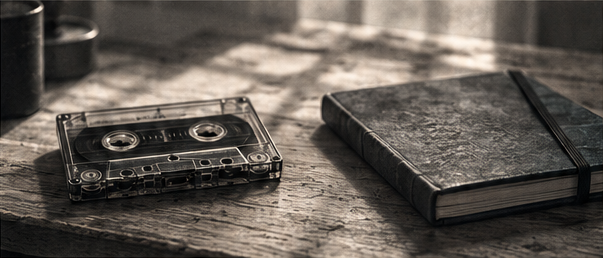
The result was The Ranleigh Tapes, a novella presented as the transcription of those recorded sessions. The pauses, interruptions, occasional humour and exchanges with his sponsor are all part of how Ranleigh tells his story.
The inventory itself never appears in the finished book. It was a working document that helped me understand Ranleigh and gave his confession its shape. And I still have it, tucked safely away in a drawer.
I find it interesting that the two books developed in almost opposite ways.
In Meeks, what I thought would be a short prologue grew into a 13-chapter Prairie Gothic that I hadn't originally planned.
With The Ranleigh Tapes, I deliberately wrote an entire document that readers would never see, so that I could write the story they would.
One book left readers with questions about Ranleigh's childhood. The other explores that childhood through a confession I prepared for by putting myself in his place.
Whether that qualifies as method writing, I don't know.
But it's how I wrote The Ranleigh Tapes.